At a large industrial manufacturing facility in Poland, Hazards Control carried out a process-led field verification of equipment associated with combustible-dust hazardous areas. The work followed the installation from bulk transfer and storage, through under-silo equipment and pneumatic conveying, to production filtration.
The engineering question was not simply whether individual components carried an Ex marking. A defensible assessment required a connection between the actual installation, the hazardous-area basis already in use and the technical evidence available for each relevant item or assembly.
- Facility type
- Large industrial manufacturing facility in Poland
- Hazard context
- Combustible dust in bulk storage, transfer and filtration systems
- Assessment type
- Independent as-built equipment and documentation verification
- Evidence reviewed
- Site observations, photographs, existing hazardous-area information, drawings and available equipment documentation
All project photographs have been cropped and digitally anonymised. Small identifier regions were reconstructed solely to prevent disclosure. The published images demonstrate the engineering context; they are not substitutes for the controlled project record or evidence for a compliance determination.
The engineering challenge
Combustible-dust installations are rarely represented by one machine and one hazardous area. Material passes through connected equipment, while the explosion hazard may differ inside an enclosure, around a potential release point and in the surrounding room or outdoor area.
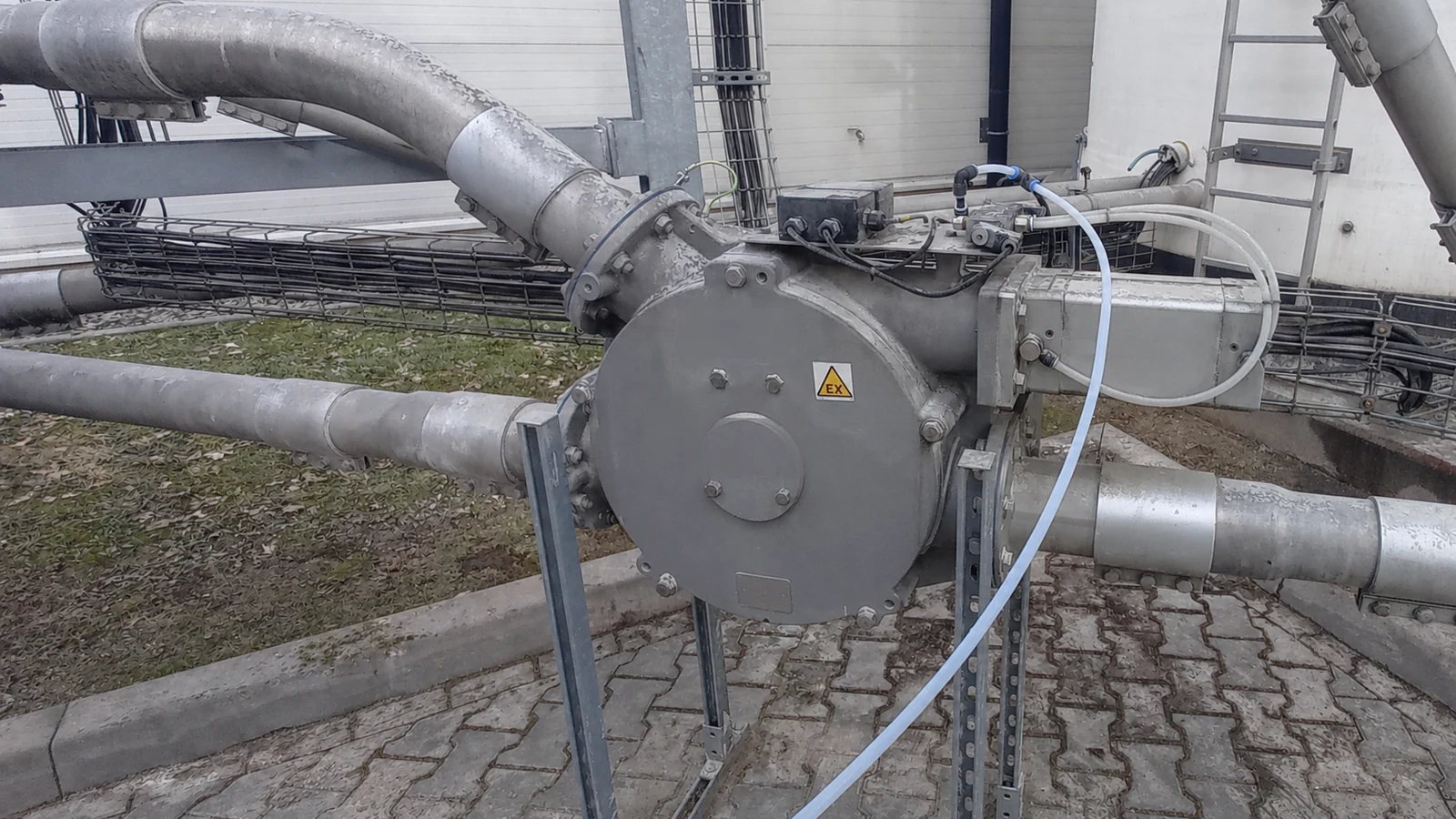
In this case, the relevant process extended across bulk delivery connections, silo-top and under-silo equipment, pneumatic conveying pipework and production filter-cyclones. The installed assemblies incorporated valves, drives, sensors, flexible elements, electrical enclosures, pneumatic equipment and process connections.
Each item had to be understood in context. A component that appears outside a classified area may still be connected to an enclosure containing an explosive dust atmosphere. Equipment at a filter or discharge point may bridge different internal and external conditions. A flexible connector may require evidence concerning temperature, pressure, intended duty and electrostatic behaviour even if it has no electrical function.
The practical task was therefore to answer four connected questions:
- What equipment and interfaces were actually present along the assessed process route?
- What hazardous-area conditions were identified in the facility’s existing documentation for those locations and equipment interiors?
- What marking, declaration, certificate, instruction or other technical evidence was available for the installed configuration?
- Where did the as-built installation, the documented classification and the available equipment evidence require reconciliation?
Scope of the verification
The work began with the hazardous areas identified in the facility’s existing Explosion Protection Document and the technical documentation made available for the installation. Hazards Control then used a sequence of site inspections to verify the relevant equipment in its process context.
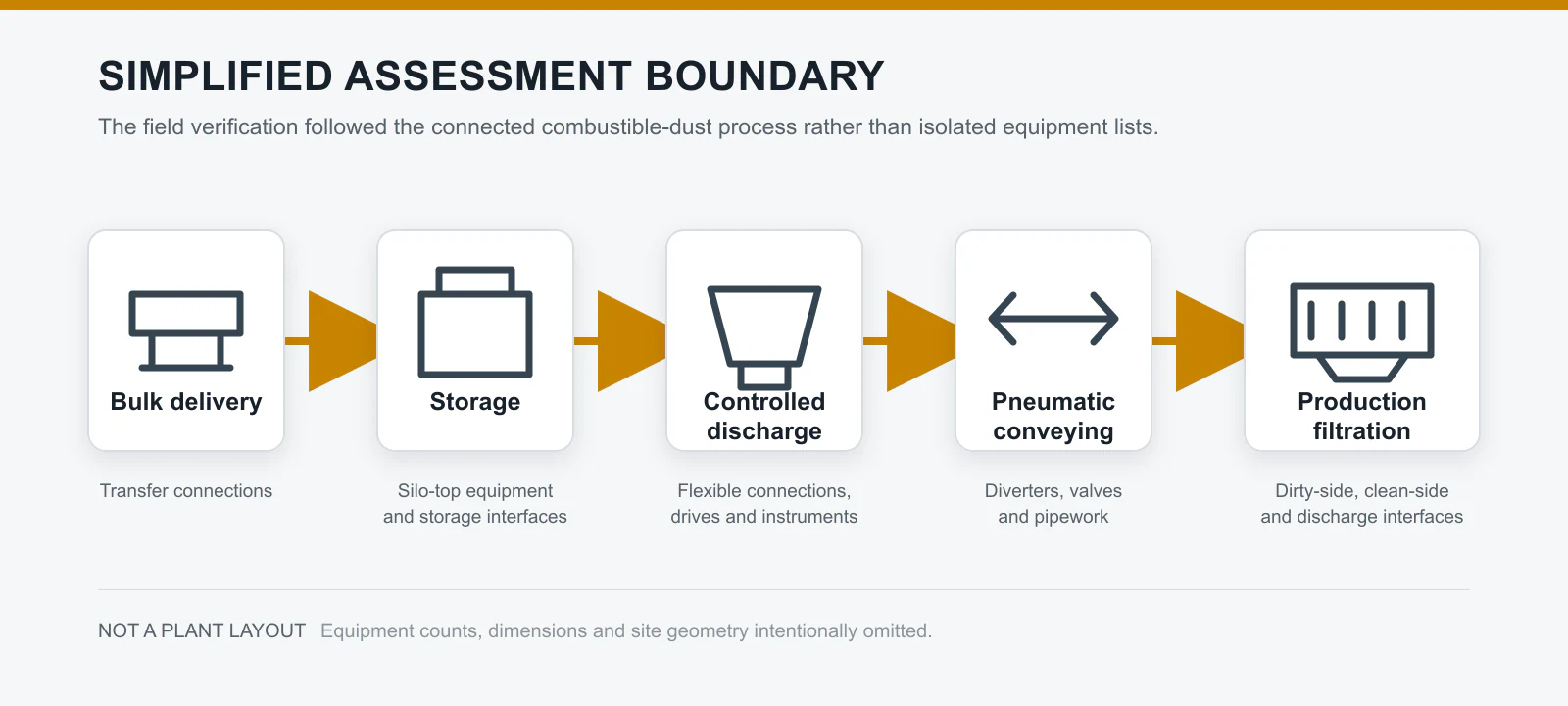
The assessed sequence included:
- bulk transfer connections associated with filling the storage system;
- equipment at the tops of the silos, including filtration and vent-related interfaces;
- equipment below the silos, including discharge arrangements, drives, instrumentation and flexible process connections;
- pneumatic conveying equipment and changeover points between storage and production;
- production filter-cyclones and the interfaces between their dirty side, clean side and clean-air discharge route.
The scope was an inventory and evidence-verification exercise. It did not replace the need for a separate calculation or a wider explosion risk assessment where the available evidence identified such a need.
How the installation was investigated
1. The process boundary was followed in the field
The inspection did not treat each room or equipment list as an isolated document section. The relevant route was followed from the incoming transfer point through storage and onward to production filtration.
2. Equipment was recorded in its actual context
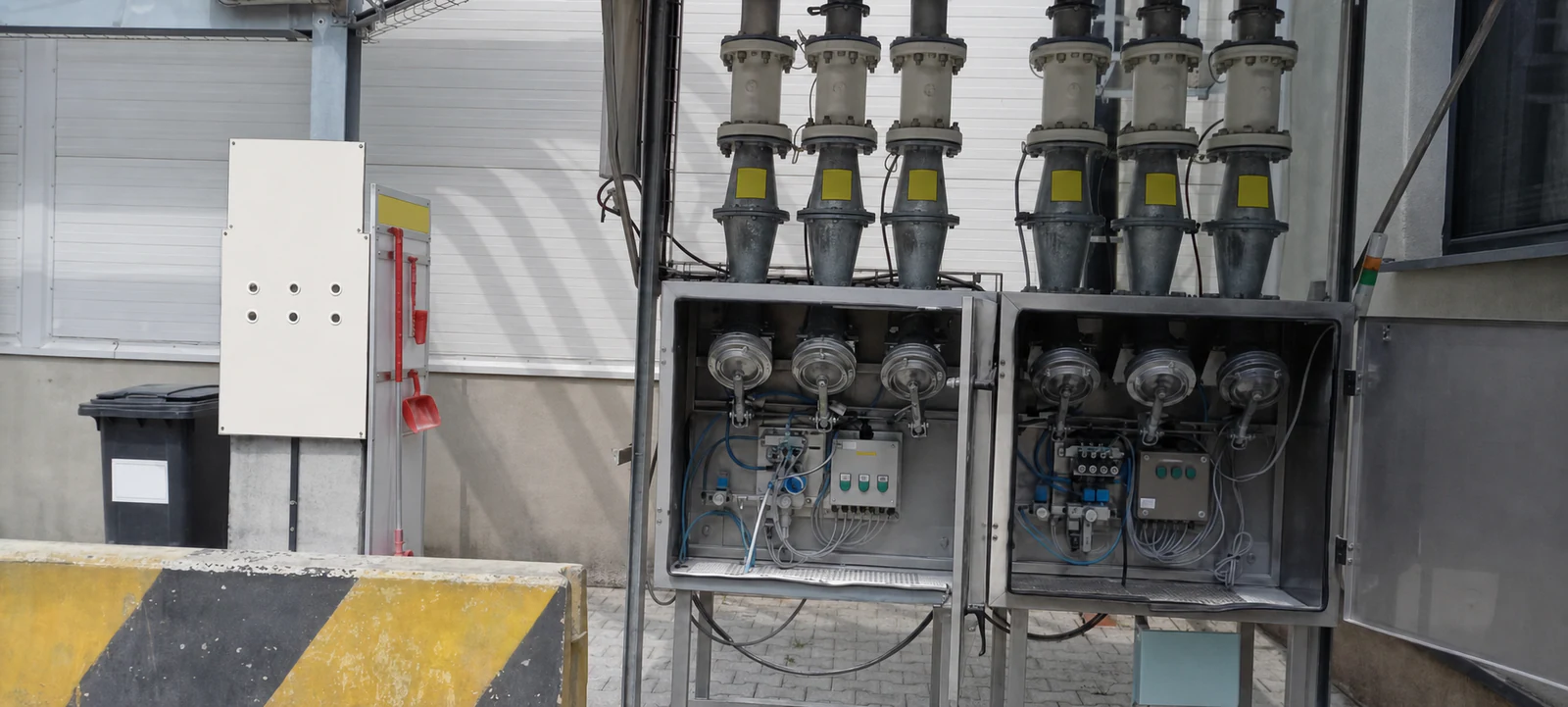
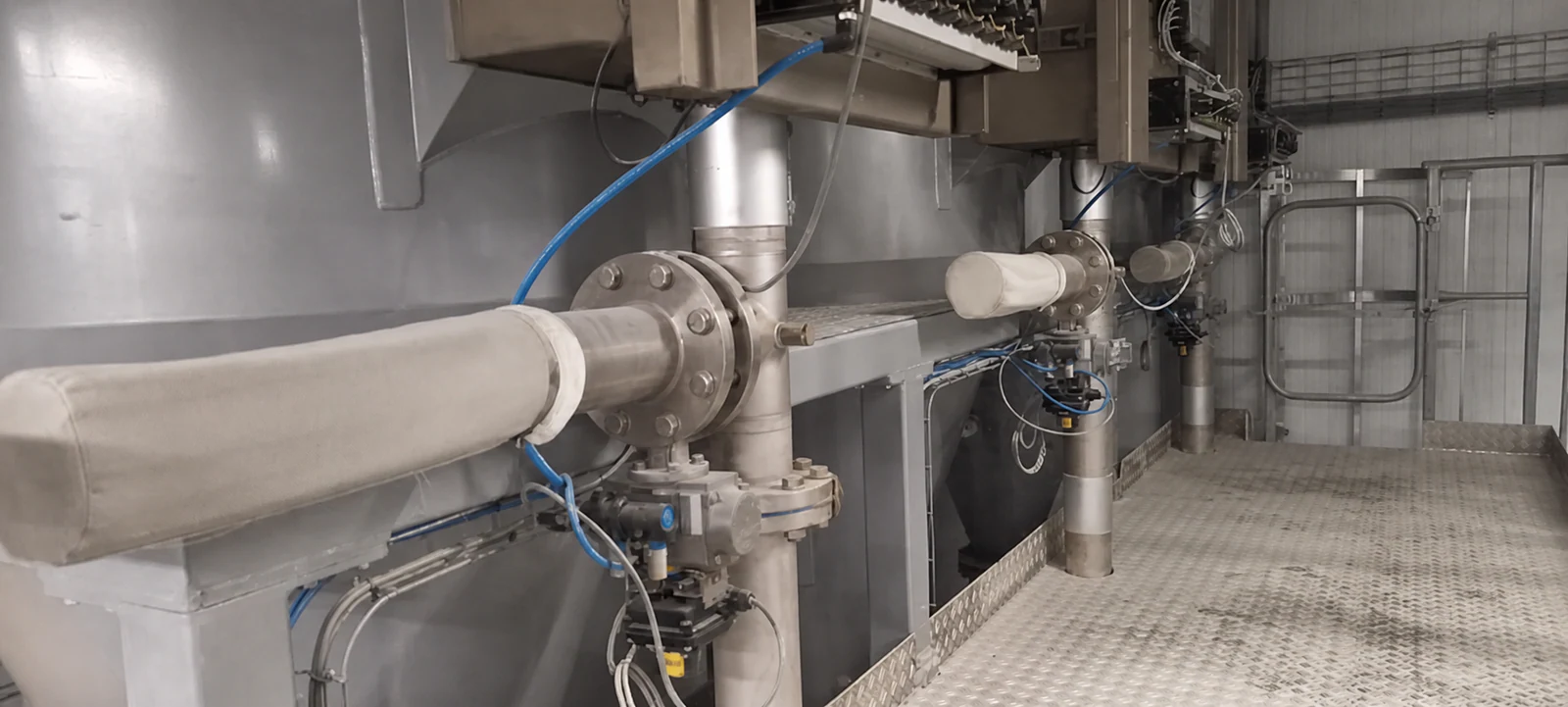
Photographs captured both the equipment and its connection to the process. Close views supported marking checks; wider views retained the relationship between pipework, valves, filters and discharge points.
3. Internal and external conditions were kept distinct
The review considered whether the relevant hazardous condition existed inside process equipment, outside it, or on both sides of an interface. That distinction affects equipment and installation checks.
4. Installed items were reconciled with available documentation
Drawings, descriptions and existing hazardous-area information were compared with the as-built condition. Items that could not be traced or clearly matched were recorded as evidence gaps.
5. Questions were separated from conclusions
The absence of a visible marking is not, on its own, proof that equipment is unsuitable. A drawing discrepancy also does not automatically mean that an installation is unsafe. These observations define what must be verified before a reliable compliance or investment decision can be made.
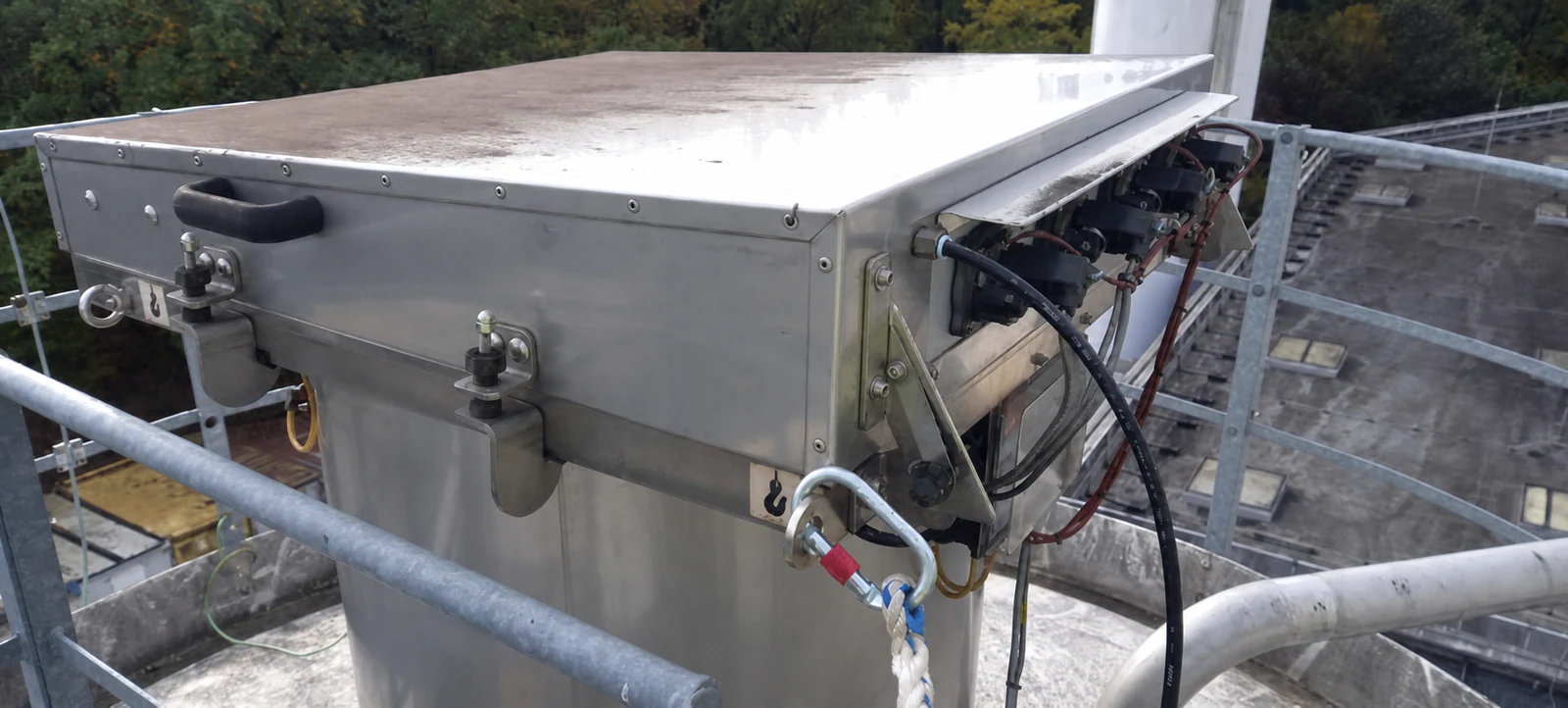
Selected findings
The value of the review lay in the pattern across the installation rather than in a single isolated observation.
Marking and traceability were not always sufficient for a decision
For a number of inspected components, the field record did not provide a visible Ex marking or a complete documentary link to the installed item. In other cases, a marking was present but still had to be read together with the manufacturer’s instructions and the actual duty.
The appropriate next step was not to assume that every such item required replacement. It was to recover and verify the relevant declaration, certificate schedule, instructions or assembly documentation, and then compare that evidence with the location and process conditions.
The as-built installation was more detailed than the available drawings
The field records identified components and interfaces that were missing, insufficiently described or inconsistently named in the available drawings and equipment information. Hazardous-area and equipment decisions depend on the real release path and the complete assembly, not only on the principal item shown on a schematic.
Category-to-zone suitability required contextual verification
At selected filtration and conveying interfaces, the documented zone and the category indicated for an item raised a question that could not be resolved from a photograph alone. The installed configuration, intended use, manufacturer documentation and the internal and external hazardous conditions had to be considered together.
An Ex marking is meaningful only when it is matched to the complete duty for which the equipment is installed.
Flexible and non-electrical elements required their own evidence
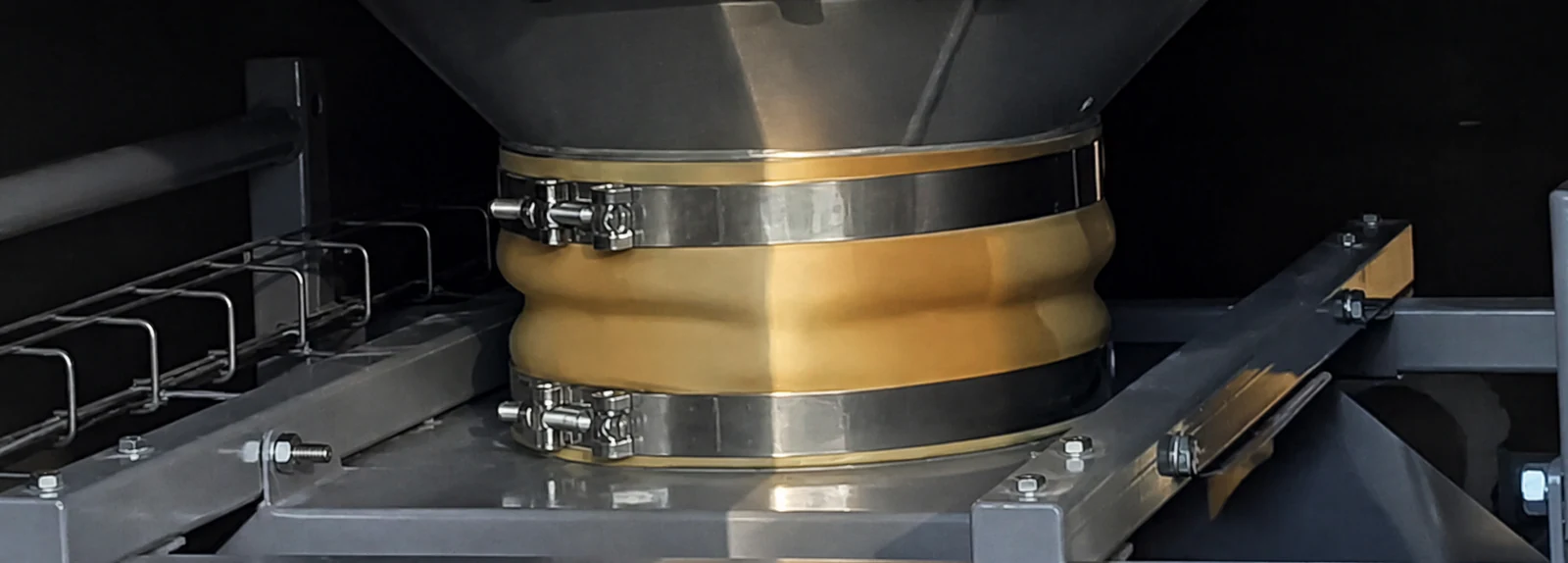
Flexible connections and material interfaces formed part of the assessed process. Their suitability may depend on pressure and temperature resistance, mechanical durability, conductivity or dissipative behaviour, bonding arrangements and the manufacturer’s intended application.
Treating these elements as minor accessories can leave an important gap between the nominally compliant machines on either side.
Hazardous-area boundaries had to reflect the actual process path
The field record identified locations where external components or clean-air discharge interfaces required further reconciliation with the existing hazardous-area documentation. The release scenario, dust layers, direction of flow, normal and abnormal operating conditions and the basis of the original classification must be verified before changing either the zone or the equipment.
From observations to a usable decision path
The purpose of this type of verification is to convert a dispersed technical problem into a controlled sequence of decisions.
- Confirm the relevant hazardous-area basis and the actual process boundary.
- Establish an as-built register of equipment and interfaces within that boundary.
- Recover the available declarations, certificates, instructions and assembly documentation.
- Check whether each item is suitable for its actual internal and external duty.
- Correct drawings, equipment registers and hazardous-area records where they do not represent the installation.
- Define only those modifications, replacements or additional analyses that remain technically necessary.
This order matters commercially. It helps the owner distinguish a missing-document problem from a classification problem, an installation problem or a genuine equipment-selection problem before committing to a larger expenditure.
The output from the field work was structured to support that decision process: location-based equipment records, photographs of the installed context and markings, documented evidence gaps, and technical questions requiring verification or further assessment.
Why independent verification can be useful
Complex industrial installations are often assembled over time from packages supplied by different parties. Designers, equipment manufacturers, installers and maintenance contractors may each hold only part of the relevant information.
An independent review can complement their work by testing whether the complete technical story is coherent from the owner’s perspective:
- Does the hazardous-area basis represent the current process?
- Can the installed equipment be traced to the correct technical evidence?
- Do the manufacturer’s conditions of use match the installed configuration?
- Are internal and external dust conditions treated consistently?
- Which actions are necessary, and which questions can first be resolved by recovering evidence or correcting documentation?
The documented scope was an evidence-verification exercise, not a procurement proposal for a replacement machine or protection system. The work was centred on the information required for the facility owner to make a technically informed decision. It complements Hazards Control’s broader fire and explosion safety services and documented engineering experience.
Where this approach is relevant
The same process-led verification can be useful when an owner, investor or engineering organisation needs to:
- review an existing combustible-dust installation before modification or expansion;
- verify contractor or designer assumptions against the as-built facility;
- check whether an equipment register and hazardous-area drawings remain reliable;
- investigate gaps in Ex markings, declarations, certificates or instructions;
- assess equipment that bridges internal and external hazardous conditions;
- obtain a confidential second opinion before selecting a technical solution;
- support technical due diligence for the acquisition or redevelopment of an industrial facility in Poland.
The scope can be limited to a defined technical question or extended where the evidence shows that a wider assessment is justified.
Technical basis
The verification of an operating facility requires a clear distinction between the employer’s workplace obligations, the product-conformity framework that applied when equipment was placed on the market, relevant standards and project-specific engineering judgement.
For a current project in Poland, the legal starting points include the Polish requirements for workplaces in which explosive atmospheres may occur and the Polish product requirements implementing ATEX Directive 2014/34/EU. Applicable standards are selected according to the task, equipment, installation date and decision being made; the latest standard is not automatically a retrospective pass/fail criterion for every legacy item.
Selected current references
- Directive 1999/92/EC and the Polish Regulation of 8 July 2010 (Dz.U. 2010 No. 138 item 931) — workplace explosive-atmosphere duties.
- Directive 2014/34/EU and the Polish Regulation of 6 June 2016 (Dz.U. 2016 item 817) — equipment and protective systems intended for explosive atmospheres.
- PN-EN 1127-1:2019-10 — basic concepts and methodology for explosion prevention and protection.
- PN-EN 60079-10-2:2015-06 — classification of areas with explosive dust atmospheres. IEC 60079-10-2:2026 was published in June 2026; adoption and the applicable project basis should be confirmed when new work begins.
- PN-EN IEC 60079-14:2025-06 and PN-EN IEC 60079-17:2024-09 — electrical Ex installation design, selection, installation, inspection and maintenance.
- PN-EN ISO 80079-36:2016-07 and IEC TS 60079-32-1:2013 + AMD1:2017 — non-electrical equipment and electrostatic-hazard guidance.
Technical basis reviewed: 11 August 2026. The applicable basis must be confirmed for each new project.
Discuss a technical problem confidentially
If your facility has an unresolved question concerning combustible dust, hazardous-area classification, Ex equipment or inconsistent contractor documentation, you can discuss it directly with the specialist who would review the technical evidence.
An initial conversation can define the decision to be made, the minimum documents required, and whether a desk review, site verification or wider assessment is proportionate. Sensitive documentation can be shared after the scope and confidentiality arrangements have been agreed.